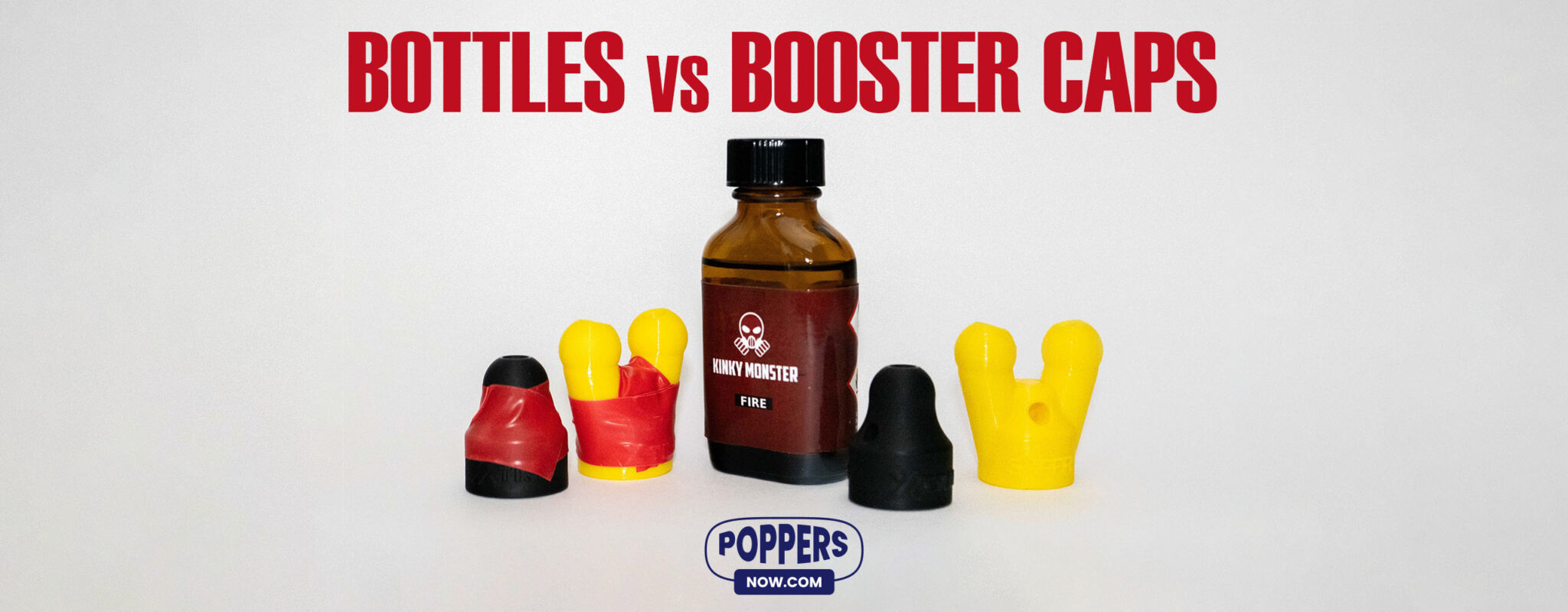
Bottles vs. Booster Caps: Who Wins? We Challenged Ourselves and 5 Guys to Give Us Their Thoughts
We talk so much about poppers that sometimes we take things for granted. Change perspective and suddenly there is a whole bunch of things worth exploring.
In this case: booster caps! Why would you want to buy one? What do they actually change? What is really different about them? And what do real users notice when they switch from huffing directly from a bottle to a cap?
Short answer: in our small test with five users, there was no single winner. The Solo was the easiest to fit consistently, the Double worked well for those whose nose suited the spacing of its two outlets, and one participant preferred the bottle because he felt more in control.
Our starting point was simple: a bottle has one opening and a booster cap changes that. It can change the diameter, add separate air intakes and, with a double booster cap, turn one upper outlet into two.
One opening, two openings, a couple of holes on the side. It all looks pretty simple and sounds great. But what do those openings actually do for your huffing experience? We want to know!
So we decided to do a couple of things our own way. First, we picked two booster caps and measured them ourselves. We made some assumptions (why not!) and then, to see whether those assumptions made any sense in real life, we put together a small focus group of five huffers and asked for their feedback.
How scientific of us! Well, more or less… one thing we did not measure is how much nitrite anyone inhaled. Firstly because, frankly, we do not have the equipment to measure it, and secondly because we wanted to hear real experiences. Less theory, more huffing!
Our questions were:
- How did the bottle compare with the booster caps?
- What differences did users notice between the Solo and Double?
- What changed when we covered the side air intakes?
- What did the guys actually like or dislike?
The Tools: Booster Caps
For this experiment we picked two products:
We sell a variety of XTRM products at Poppers-Now and collaborate directly with them, so they were an obvious place to start. We chose size S because some of our most popular poppers use an S thread. We chose size S because some of our most popular poppers use an S thread. Not sure which cap fits your bottle? Our poppers accessories guide explains the different cap types and how to choose the right size.
The Measurements
We looked at two features on the booster caps:
- the upper outlet or outlets,
- the side air intakes.
We also measured the opening of an S bottle for comparison.
What we measured
| Product | Approx. upper opening | Approx. side air intakes |
|---|---|---|
| S thread bottle | 12mm (≈ 113mm2) | None |
| XTRM Solo Small | 1 × 6mm (≈ 28mm2) | 2 × 3.8mm (≈ 23mm2 combined) |
| XTRM Double Small | 2 × 5mm (≈ 39mm2 combined) | 2 × 5mm (≈ 39mm2 combined) |
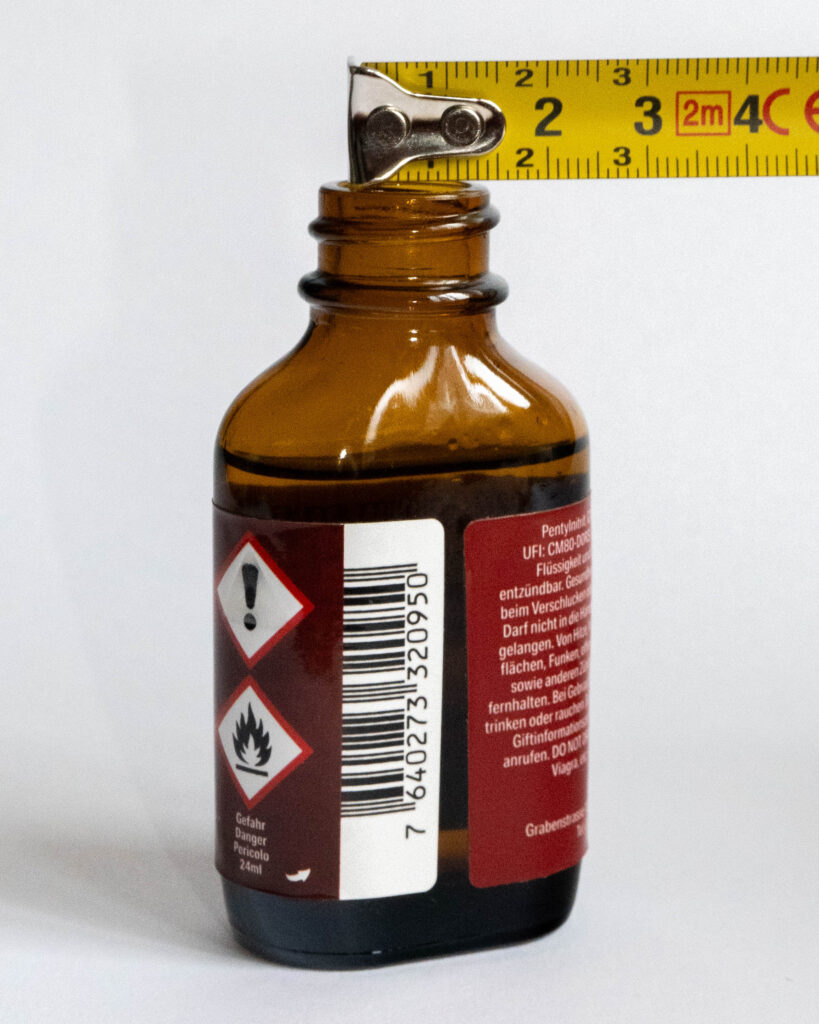
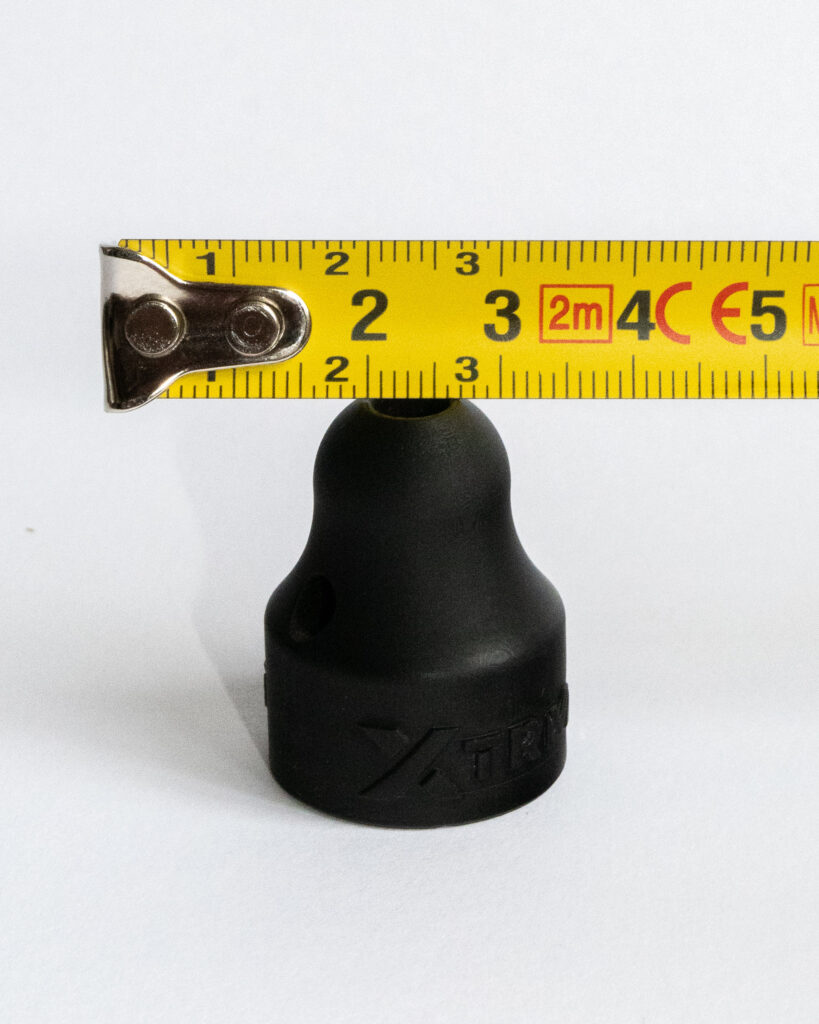
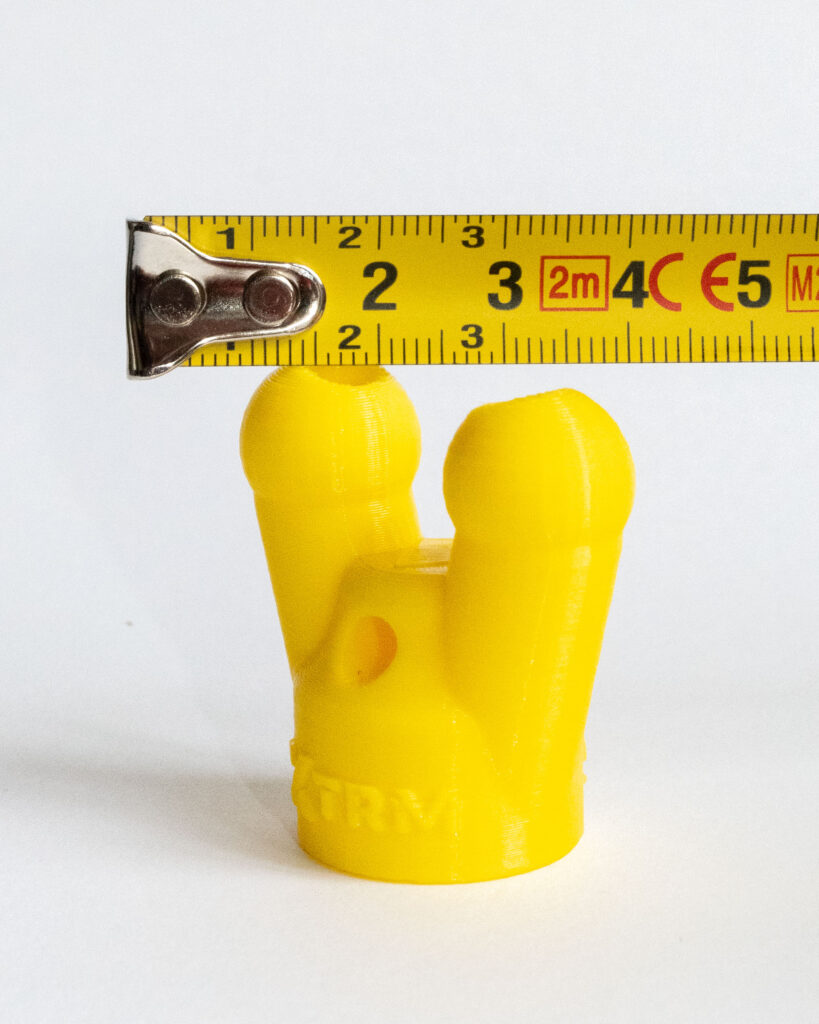
Bottle opening + Solo upper outlet + Double upper outlet.
What stood out was that the Double is not simply a Solo with another hole stuck on top. Its individual upper outlets are smaller, while its side air intakes are larger. And! If we use our approximate diameters and calculate the circular opening area, the Solo has an upper opening area of roughly 28mm². The Double, with two 5 mm openings, has a combined upper opening area of roughly 39mm².
So the Double does have a larger total upper opening area than the Solo, but it is still not “double.” Already, we can throw one assumption out of the window: two outlets do not automatically mean twice as much.
For comparison, the 12 mm bottle opening has an area of roughly 113mm². So the bottle opening is much larger than either booster-cap configuration: about four times the Solo’s upper opening area and almost three times the Double’s combined upper opening area.
That still does not tell us how much air or nitrite actually moves through each situation, because the booster caps also have separate side air intakes. But it does show that comparing only the visible upper openings gives us a very different picture from the bottle itself.
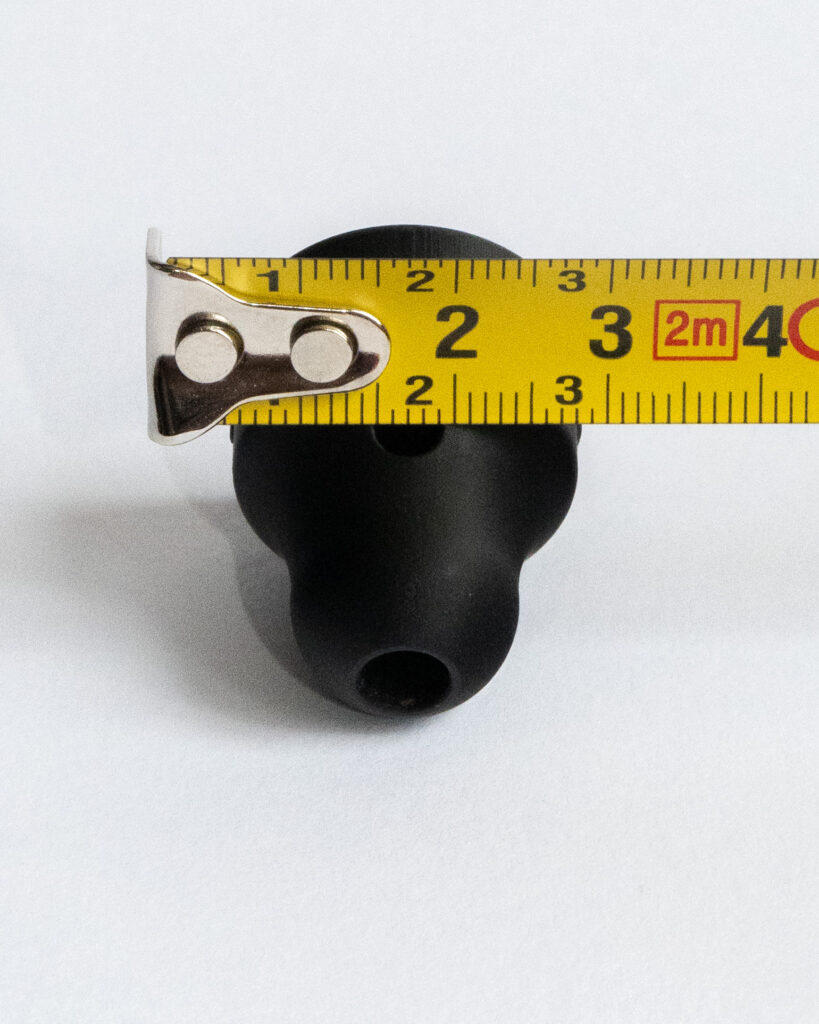
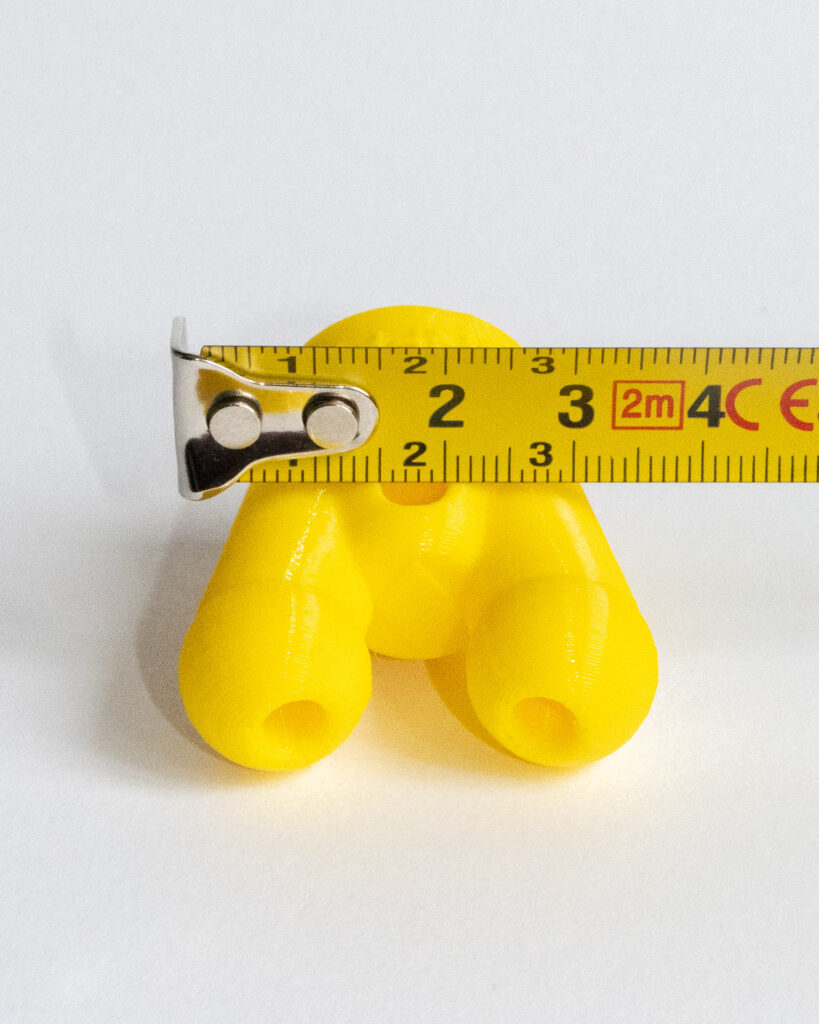
Solo and Double side air-intake measurements.
Before We Started Huffing: A Bit of Science
Poppers are volatile liquids. Some of the liquid evaporates into vapour (read fumes), inside the bottle. When you inhale, air carries that vapour with it.
For this experiment, we had to keep three things separate: the size of the openings, the way the huff feels, and how strong somebody says the experience feels.
Those things may be related, but they are not the same measurement. We measured the openings, and the guys told us what they experienced. We did not chemically measure the amount or concentration of nitrite they inhaled.
Time to Get Some Guys Involved
If we talk about booster caps ourselves, we know we are going to talk about them from a product perspective: how they work, what they offer, and why somebody might want one.
But what happens when you give the product to five different huffers? You get different opinions. And luckily for us, our participants had plenty of those.
Our five participants were aged between 25 and 65. Each participant had their own bottle, Solo and Double booster cap. A Poppers-Now team member explained the comparison, timed the rounds and took notes. We also collected additional comments after the huffing rounds were finished.
For consistency, everybody used the same product: Kinky Monster Fire 24 ml, strength 6 out of 6, with an S-thread, like the one shown in the photo before. Curious how strength levels compare? See our overview of the strongest poppers.
Round One: Bottle vs. Solo vs. Double
We compared:
- huffing directly from the S-thread bottle,
- using the Solo booster cap,
- using the Double booster cap.
The rounds followed the same timed format so we could at least keep the procedure reasonably consistent. Here our results:
Straight From the Bottle
This was actually interesting from the beginning because there was no single “bottle experience.” Different users held the bottle at different distances from the nostril. Some came closer, some stayed farther away.
Their descriptions also varied a lot, from a mild kick to a strong hit. That gave us our first useful reminder: even when everyone is using the same bottle, people do not necessarily use it in exactly the same way. If you are new to this, start with our beginner’s guide to poppers.
Solo Booster Cap
The Solo produced more similar feedback across the group. Participants found it easy to position, and the shape made it easier for them to create a close fit around the nostril.
The descriptions of the effect were also similar, with several users describing a strong kick. Some users used words such as “clean” or “pure” to describe the sensation. That is their experience, and by no mean a chemical finding. Yet as a description of how it felt, it came up more than once.
Double Booster Cap
The Double had more to talk about, starting with the shape. Not everybody could create the same seal with the Double because the spacing between the two upper outlets naturally fit some noses better than others.
For those where it fit comfortably, users liked having the fumes coming through both nostrils and not having to close one nostril with a finger. But the reported effect varied more than with the Solo, from mild to strong. For us, one thing became obvious: the Double is not only about having two outlets, the shape of your nose changes the experience.
Then We Started Taping Things
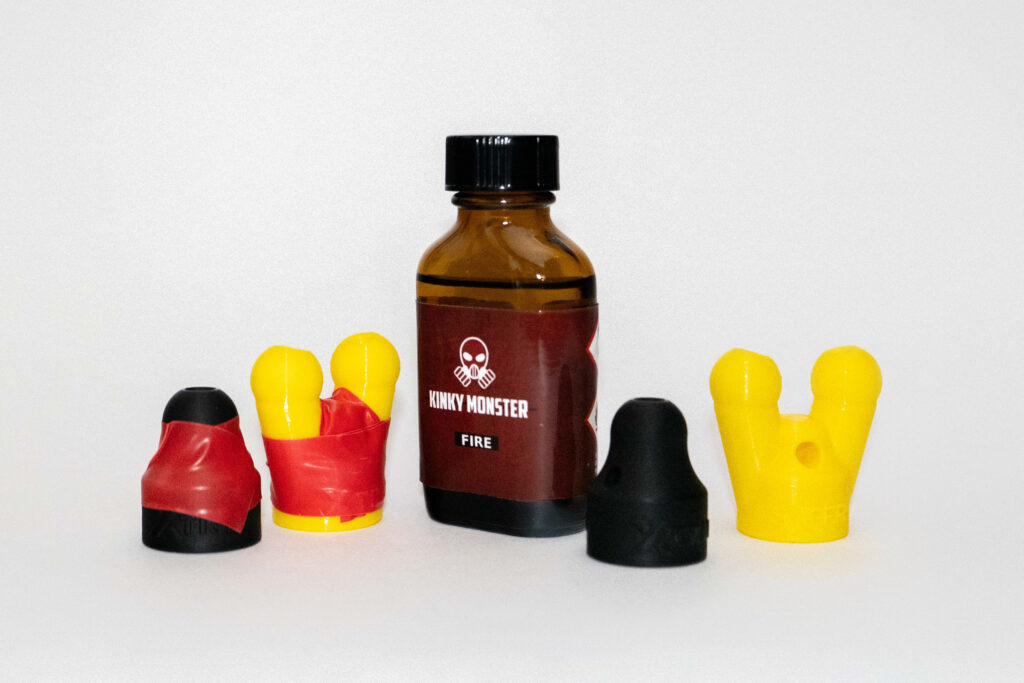
The complete test set with the covered Solo and Double on the left, Kinky Monster Fire in the centre and the normal caps on the right.
With the air intakes covered, something interesting happened. Participants said the effect felt more similar to huffing directly from the bottle, but when they created a close seal with the booster cap they felt they had to huff harder.
In other words, there was more perceived resistance. With the intakes open, that resistance was not felt.
The Solo made the role of fit even more obvious: the closer the seal with the nose, the more noticeable the resistance became when the side intakes were covered.
That does not tell us exactly how much air moved through the cap. And it definitely does not tell us how much nitrite was delivered. But from a user-experience perspective, it told us something useful: the side air intakes clearly changed how the huff felt.
So perhaps “booster” is not just about that small upper opening everyone notices first. The whole airflow path, including those two side openings, is part of the experience.
And Then We Let Them Talk
Once the structured comparison was finished, we asked the guys what they actually thought. A part turned out to be just as useful and nice as the test itself.
One user liked the fact that the cap kept them from handling the bottle opening as much:
“I huff a lot and everytime I clean the bottle with my hand, that chemical finishes on my penis. With a cap this problem can be avoided.”
He explained that residue transferred from his hand to his penis kept causing irritation.
Another liked the consistency of the experience:
“I like that the experience is clean and is always available.”
They also liked being able to change how hard they huffed.
And one comment required absolutely no scientific interpretation:
“Huffing with a cap looks so horny, like a machine huffing from the bottle.”
Well-noted!
But not everyone preferred the booster. One participant told us:
“I prefer huffing from the bottle, it gives me more control…”
For him, the booster felt more intense by default, and that was not necessarily his style of huffing.
Other Very Practical Questions Came Up
Not everything was about the strength of the hit. One person wanted to know:
“I’m not sure how to clean the nozzle, when is it really clean?”
They could still smell poppers on the cap after removing it and were unsure how to properly clean the product.
Another pointed out the obvious problem of bottle compatibility:
“It’s a practical solution but you probably have to have a lot of sizes of these things to fit all the different bottles.”
Cleaning instructions, bottle compatibility and sizing might sound less exciting than airflow, but these comments gave us better insights into what is actually useful to talk about for our customer.
So…Who Won?
Let us first summarize our original questions.
- How did the bottle compare with the booster caps?
There was no real winner. The bottle produced everything from mild to strong experiences. The Solo produced more similar reports across our group and was generally described as easy to use. The Double produced more variation, with fit playing an important role. And one participant still preferred the bottle because it gave him a greater sense of control. - What was different between the Solo and Double?
Our measurements showed that the Double has a larger combined upper opening area than the Solo, about 39 mm² versus 28 mm², but it is not twice as large. Its side air intakes are larger as well, while each individual upper outlet is smaller. The user experience was also different. The Solo was easier for our participants to fit consistently. The Double gave some users an enjoyable two-nostril experience, but the shape of the nose yielded different results. - What happened when we covered the side air intakes?
Participants reported more resistance and said they had to huff harder when they formed a close seal. They described the effect as closer to huffing from the bottle. That tells us that the side intakes are essential. - What did people actually like or dislike?
The likes were not only about intensity: people mentioned convenience, fit, appearance and the experience of using both nostrils. The negatives? Participants mentioned control, cleaning and compatibility. Which, for us, may actually be the most useful result of the whole experiment.
What We Learned
We started by looking at a couple of holes in a booster cap, and we ended up talking about airflow, nose shape, resistance, control, cleaning, bottle compatibility and whether something looks horny enough to use. Not bad for a first try!
We also learned that a booster cap cannot really be explained by saying “smaller opening = stronger hit” or “Double = twice as much punch.” Our own measurements already show that the geometry is more complicated than that. And our users made the rest clearer.
Our measurements tell us how these particular products are built. Our five guys tell us how they experienced them. That does not give us an exact number for nitrite delivery, and it was never supposed to. It gives us something more useful for this article: a real-world look at what changes when you switch from huffing straight from the bottle to using a booster cap. If you are curious about other ways to change how you huff, from sniffer caps to popper masks, take a look at our guide to creative inhalation methods.
This also gives us enough material for our next experiment! Let us know what you think and how you experience huffing from the bottle vs from a booster cap.
Thank you for reading!