
- Andreas Hungerbühler
- 15. November 2023
Understanding Poppers: A Comprehensive Guide to their Ingredients
Post updated on July 26, 2026.
Poppers contain nitrites, which are alkyl esters of nitrous acid. The specific type of nitrite used in poppers can vary depending on where you purchase them, and this can result in different health risks associated with their use. Labels don’t always make it obvious which one you’re getting.
At www.poppers-now.com, we are committed to providing poppers with ingredients that we classify as lower-risk. Here are the nitrites commonly found in poppers in the USA today, followed by what we deliberately leave off our shelves and why.
Nitrites We Sell
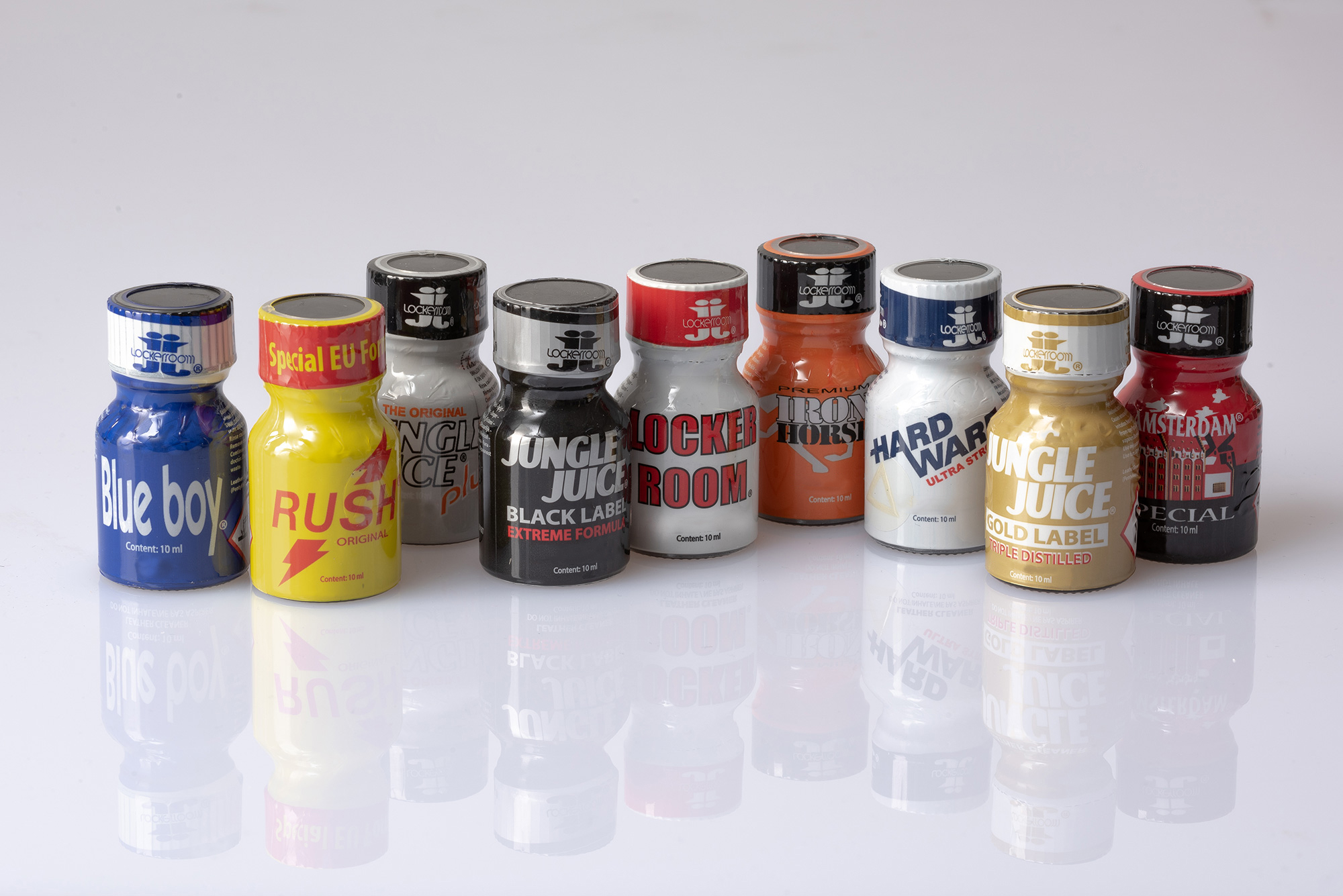
- Pentyl nitrite (CAS 463-04-7): Most of our products contain pentyl nitrite. You can find this nitrite in Rush Fire Poppers, for example. It’s the basis for most modern poppers formulas sold in the US market.
- Hexyl nitrite (UFI V300-A06S-K00V-G02P): Used across a broad share of our range, from several manufacturers and in a range of bottle sizes. You’ll find it in select Rush, Jungle Juice, and Blue Boy products, among others. It shares a similar risk profile to pentyl nitrite.
- Canadian Pentyl Formula (EC number 951-169-0, RM): This is a new substance from the manufacturer Lockerroom in Canada, based on pentyl nitrite, and is also considered less harmful. For example, it can be found in the popular Amsterdam Special Poppers 10ml.
- Isoamyl alcohol nitrite (UFI KR2F-EY6P-GSK6-YHX7): This ingredient is found, for example, in Twisted Beast’s Sissy Poppers.
- n-Pentanol nitrite (UFI 991E-1FCP-A00J-NNDR): For example, this nitrite is found in Iron Fist Poppers Ultra Strong.
Nitrites We Don’t Sell
- Isopropyl nitrite (CAS 541-42-4): Products containing this nitrite are not sold by us. It’s specifically associated with “poppers maculopathy”. A retinal condition that first appeared in case reports after isopropyl nitrite replaced isobutyl nitrite as the dominant compound in the UK market around 2007.1
- Isobutyl nitrite (CAS 542-56-3): This nitrite is found in products like Quicksilver, RAM, and Rave. We do not sell products with isobutyl nitrite. The International Agency for Research on Cancer (IARC) evaluated isobutyl nitrite in 2018 and classified it as “possibly carcinogenic to humans” (Group 2B), based on evidence from animal inhalation studies showing increased lung and thyroid tumors.2
Why “Amyl Nitrite” and “Alkyl Nitrite” Are Red Flags on a Label
It’s important to note that the term “amyl nitrite” is a collective term, and “alkyl nitrite” is a collective term for various nitrites, including isobutyl nitrite, pentyl nitrite, isopropyl nitrite, and others. We do not recommend poppers with these generic terms, as it is unclear which specific nitrite is contained in these products.
The Bigger Safety Picture
Nitrite inhalants are not evaluated or approved by the FDA for any use, and the FDA has issued a direct consumer warning that ingesting or inhaling nitrite products can cause serious injury or death, including drops in blood pressure, oxygen deprivation, and heart arrhythmia.3
This is why product choice and correct use matter. If you’re new to poppers, start with our beginner’s guide and safety tips, review our full instructions for use, and know what to do in an emergency before you use any product.
How We Verify What’s in the Bottle
Unlike many poppers retailers, we document our products in the official Swiss Product Register for Chemicals (RPC), which gives you a way to verify ingredient claims through an official source rather than taking a label at face value. Read more about our quality and product registration standards.
References
1 Davies, A.J.; Kelly, S.P.; Naylor, S.G.; et al. Adverse ophthalmic reaction in poppers users: case series of ‘poppers maculopathy’. Eye. 2012;26(11):1479–1486. nature.com/articles/eye2012191
2 International Agency for Research on Cancer (IARC). Isobutyl Nitrite, β-Picoline, and Some Acrylates, IARC Monographs Vol. 122 (2019). ncbi.nlm.nih.gov/books/NBK558046
3 U.S. Food and Drug Administration. Ingesting or Inhaling Nitrite “Poppers” Can Cause Severe Injury or Death (2021, content current). fda.gov